

A CNC production cell training plan should be accepted only when it teaches the actual cell hazards, operating modes, safeguards, allowed tasks, supervised practice steps, and readiness checks before production release.

Start with the cell’s hazards, safeguards, and operating modes
Begin the training scope by identifying how the specific cell operates, how it starts and stops, where hazards exist, what safeguards are installed, and which worker tasks expose people to the machine.
For a mold-base factory or steel-processing shop, the training plan should be built around the real production route: loading stock, selecting or confirming the program, setting or checking workholding, observing the first cycle, handling finished work, measuring results, and responding to abnormal conditions. A generic classroom session is useful only if it is connected to the cell that operators will actually use.
- Walk through normal start, stop, and restart behavior so operators know what the machine is expected to do before they take control.
- Identify built-in hazards, including moving machine elements, cutting zones, workholding areas, chips, coolant, and points where manual interaction may be required.
- Review the safeguards and interlocks that are part of the cell, and make clear that guards are not training props to be bypassed.
- Separate engineering controls, work practices, and personal protective equipment so operators understand that instructions and PPE do not replace proper safeguards.
- Define what an operator may do alone, what must be supervised, and what must be escalated to maintenance, engineering, or a qualified setter.
Do not accept a training plan that treats operator attention as the main risk control. Training should reinforce engineered safeguards, defined procedures, and appropriate PPE rather than compensate for missing controls.
Set safety boundaries before the first production run
Safety training should explain the controls already built into the cell, the procedures operators must follow, and the PPE required for the task; it should not imply that instruction alone makes the cell safe.
A practical training package should follow the hierarchy-of-controls logic: design and engineering controls come before administrative rules and PPE. Operators still need clear procedures, but those procedures should be aligned with the way the equipment and work area are controlled.
| Training boundary | What the buyer should require | Why it matters |
|---|---|---|
| Machine operation and stop/go behavior | A demonstration of normal start, hold, stop, restart, and abnormal-condition response for the actual cell. | Operators need to understand the machine actions that can create exposure during production work. |
| Safeguards and access points | Instruction on guards, interlocks, safe observation positions, and restricted access areas. | Training should help workers recognize built-in hazards and the protective function of safeguards. |
| Procedures and PPE | Task-specific procedures and PPE requirements that support, not replace, engineered controls. | Administrative controls and PPE are lower-order controls and should not be the only protection relied on. |
Before any permitted manual access, inspection, chip clearing, cleaning, adjustment, or maintenance-related task, operators should switch off the equipment and disconnect or isolate the applicable electrical, hydraulic, pneumatic, stored-energy, or battery power source according to the site procedure and the machine manual. Manual access should stay within the tasks that the employer and machine documentation authorize for that role.
Map each role to the tasks it is allowed to perform
Role mapping should connect each person to the CNC tasks they are allowed to perform, such as setup support, workholding checks, tool setting, dry run observation, part loading, quality checks, and routine lube or coolant duties.
The NIMS CNC Milling Operator role is a useful task-category reference because it covers hands-on work from setup and workholding through verification, test cutting, adjustment, measurement, benchwork, quality control, and maintenance-related lube and coolant duties. A factory can use those categories to avoid training gaps without copying them as a site-specific job description.
| Role decision | Train before release | Do not assume |
|---|---|---|
| Production operator | Part loading, cycle observation, basic measurement, abnormal-condition reporting, and allowed routine checks. | That attendance alone qualifies the operator for setup, process adjustment, or maintenance tasks. |
| Setter or lead operator | Workholding alignment, tool assembly and setting, verification, dry run, test cutting, and controlled adjustment. | That a setter’s authority transfers automatically across every new cell or fixture arrangement. |
| Quality or process technician | Measurement method, inspection points, process feedback, and when to stop production for review. | That inspection knowledge replaces machine-operation training for people who must approach the cell. |
Verify competence with observed tasks, not attendance alone
A release-to-production plan should verify that operators can perform assigned tasks under observation, not only that they sat through a class or signed a form.
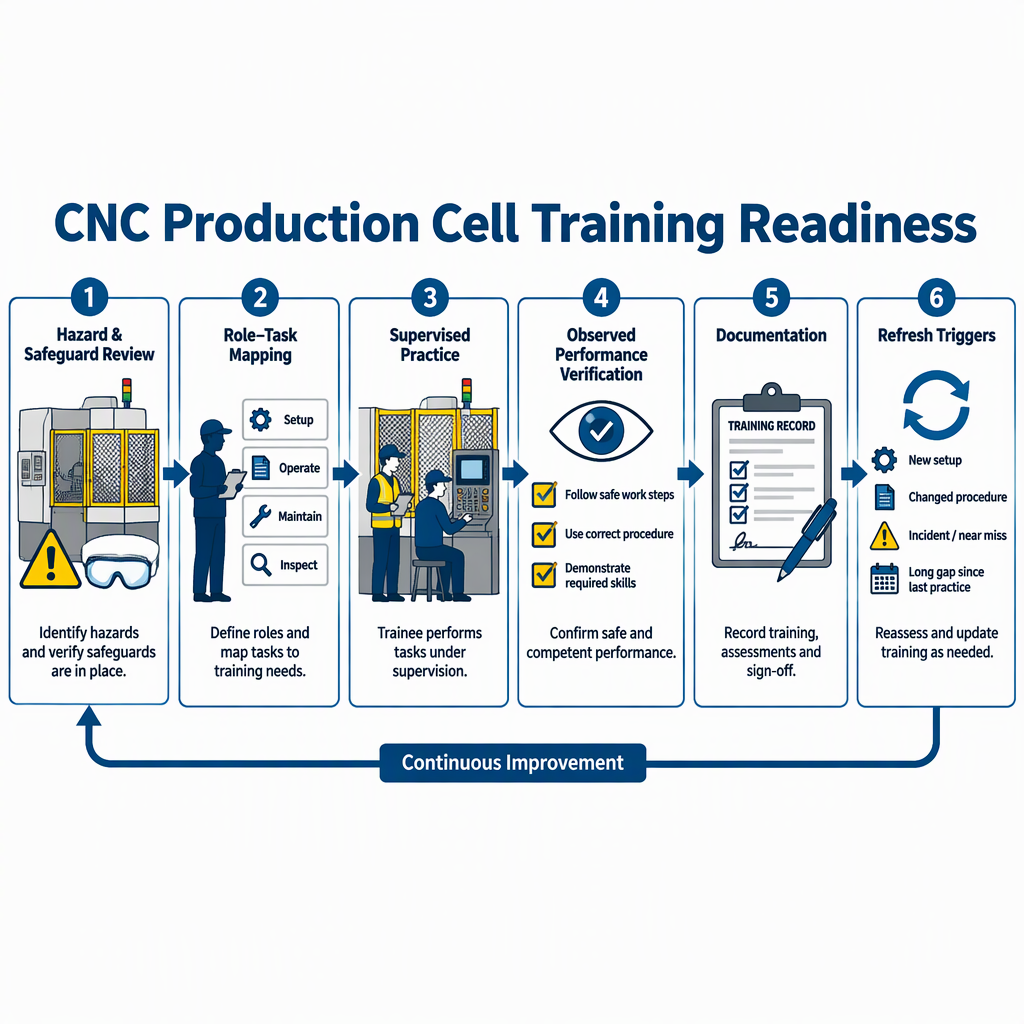
NIMS credentialing uses duty-specific standards and commonly combines knowledge exams with performance evaluation methods such as observed hands-on skills checks, projects, or performance measures. For a new CNC cell, that supports a practical readiness model: teach the duty, supervise the task, observe performance, document the result, and restrict unsupervised work until the operator is ready.
- Select the task categories that apply to the cell, such as workholding, tool setting, dry run, part loading, process adjustment, and measurement.
- Teach the knowledge portion, including terminology, sequence, limits, alarms, escalation points, and documentation expectations.
- Use supervised practice so the operator can demonstrate the task in the work environment rather than only describe it.
- Record observed performance against a defined checklist before releasing the operator to unsupervised production work.
- Keep separate sign-offs for tasks with different risk or skill levels, such as loading parts versus changing tools or making process adjustments.
A buyer can ask for a training record that distinguishes knowledge checks from hands-on performance checks. This keeps the acceptance conversation focused on capability, not only attendance.
Use this buyer checklist before accepting the training plan
Before accepting CNC production cell training, ask whether the plan covers hazards, safeguards, task authorization, supervised practice, competence verification, documentation, and refresh triggers.
- Does the training identify the cell’s specific operating modes, start/stop behavior, built-in hazards, safeguards, and worker tasks?
- Does the plan explain how engineering controls, procedures, and PPE work together rather than relying only on operator behavior?
- Does each role have a task boundary for setup support, loading, dry run observation, measurement, adjustment, and maintenance-related duties?
- Is there an observed performance check for each task that will be performed without direct supervision?
- Are abnormal conditions covered, including when the operator should stop, step back, and escalate to a qualified person?
- Are manual access tasks limited to the site procedure and the machine manual, with power disconnected or isolated before permitted access?
- Will the factory receive a record that separates attendance, knowledge review, supervised practice, and observed task verification?
- Does the training plan account for measurement, quality control, process feedback, and routine lube or coolant responsibilities where those tasks are assigned?
For equipment buyers, the most important purchasing question is not whether a training session is included; it is whether the session gives production people enough bounded, task-specific preparation to run the new cell safely and consistently within their authorized roles.
Limit compliance, safety, supplier, and productivity claims to documented assessments and applicable official requirements
Operator training is part of a safe production system, but it does not by itself prove legal compliance, machine safety, productivity improvement, or supplier performance.
Training belongs alongside design controls, engineering safeguards, work practices, and PPE. A factory should confirm applicable legal duties, local requirements, and site procedures with qualified safety personnel and the relevant authority for its location.
Do not treat a training certificate, sign-in sheet, or supplier handover session as proof that every hazard has been controlled. Machine safety still depends on the specific equipment, safeguards, work layout, assigned tasks, maintenance condition, and the employer’s procedures.
If a supplier or internal team offers a readiness claim, ask what was actually assessed: knowledge, hands-on performance, documentation, or a production outcome. Competence assessment can support role readiness, but it should not be translated into unsupported claims about cycle time, scrap reduction, legal compliance, or guaranteed production results.
Plan refresh training when the process changes
Refresh training should be planned whenever the cell, tooling, workholding, program flow, safeguards, assigned tasks, or operator team changes enough to affect how people interact with the machine.
CNC role tasks can include setup, workholding alignment, tool assembly and setting, verification, dry run, test cutting, process adjustment, measurement, and routine lube or coolant duties. When any of those duties move to a different person or change in scope, the training record should be updated.
- Update training after a new fixture, loading method, guarding arrangement, or operating mode is introduced.
- Repeat task verification when an operator is assigned a new duty, such as tool setting, dry run approval, or process adjustment.
- Review abnormal-condition response after recurring alarms, near misses, quality escapes, or confusion at the control point.
- Reinforce the difference between engineered safeguards, procedures, and PPE when a process change alters exposure to hazards.
- Keep records current so supervisors can see which operators have demonstrated which duties under observation.
Conclusion
Accept the operator-training plan only when it is specific to the production cell, bounded by role authority, aligned with safeguards, and verified through observed task performance.
- Start with the machine’s hazards, safeguards, stop/go behavior, and real operator tasks.
- Use training to support engineered controls and procedures, not to replace them.
- Map tasks by role so operators know what they may perform and what they must escalate.
- Verify readiness through observed performance, not attendance alone.
For a new CNC production cell, the best acceptance standard is practical: the right people can demonstrate the right tasks, within the right boundaries, before the cell is released to production.
FAQs about CNC production cell training
These answers help buyers and production engineers turn a general CNC production cell training discussion into task-specific acceptance questions.
What should operator training cover before a new CNC production cell starts production?
It should cover the cell’s operation, stop/go behavior, built-in hazards, safeguards, assigned worker tasks, and abnormal-condition response. It should also connect those items to the actual production route used by the factory.
How should safety training fit with machine safeguards and PPE?
Safety training should explain how engineering controls, work practices, and PPE work together. It should not suggest that procedures or PPE are substitutes for suitable machine safeguards.
Which CNC operator duties should be mapped by role?
Common role categories include setup support, workholding alignment, tool assembly and setting, machine verification, dry run, test cutting, part loading, process adjustment, measurement, quality control, and assigned lube or coolant duties.
How can a factory verify operator readiness?
The factory can combine knowledge review with observed hands-on performance checks. The record should show which task was observed, who evaluated it, and whether the operator may perform it without direct supervision.
Does a training session prove the cell is compliant?
No. Training supports the safety system, but compliance depends on the applicable rules, the installed equipment, safeguards, work layout, procedures, and site-specific controls. Confirm local requirements with qualified safety personnel and the relevant authority.
When should refresh training be planned?
Plan refresh training when the cell configuration, tooling, guarding, workholding, program flow, assigned duties, or operator team changes in a way that affects how people interact with the machine.
Should equipment buyers ask for productivity guarantees from training?
Buyers should ask for task-readiness verification rather than unsupported productivity guarantees. Competence checks can show whether operators can perform assigned duties, but they do not by themselves prove cycle-time, scrap, or output improvements.