


You set tolerances for machined parts by choosing limits for size, shape, and finish. By mastering tolerances for machined parts and using the right tolerancing rules, you ensure that parts are reliable in every CNC job. Exact tolerances enhance part quality and contribute to optimal product performance. Studies show that mastering tolerances for machined parts leads to better fits, reduced waste, and increased efficiency.
Aspect | Impact on Quality and Performance |
|---|---|
Reliability | Ensures parts fit together correctly and prevents failures. |
Functionality | Enhances the performance of parts in their applications. |
Efficiency | Reduces waste and streamlines production processes. |
GooDa Machinery supports you in mastering tolerances for machined parts by emphasizing accuracy and innovation. You can achieve the highest part quality by employing a clear and organized approach.

Learn about tolerances so parts fit and work well. This helps make products better and work longer.
Find the most important sizes that help parts go together. Pay attention to these parts and use tighter tolerances if needed.
Use geometric dimensioning and tolerancing (GD&T) for more control. This makes it easier to put parts together and swap them if needed.
Pick the loosest tolerances that still let the part work right. This saves time and money when making parts.
Talk clearly with your manufacturer. Give them good drawings and details so there are no mistakes and the parts are good.
Check parts often to make sure they meet tolerance rules. This stops problems when putting things together and keeps people safe.
Do not use very tight tolerances unless you really need them. Tight tolerances can cost more and make making parts harder.
Work with your machining partner early when designing. Working together helps get better parts and makes things faster.
When you begin a CNC machining job, you must know what your part needs to do. This helps you pick which sizes are most important. It also helps you decide how close your measurements must be. The job of each feature helps you make choices. It makes sure your part works the way you want.
You should find the most important measurements first. These measurements affect how your part fits with other parts. For example, a hole for a shaft or a surface that connects to another part is a key measurement. If you pay attention to these spots, you can use tighter tolerances where they matter most. This helps you get the right accuracy and keeps your part steady for your needs.
Think about what each measurement does.
Choose which features are needed for your part to work.
Use the loosest tolerance you can for features that are not important.
Good fit during assembly depends on how you set tolerances for key measurements. If you use tight tolerances everywhere, it can cost more and take longer. Instead, use tight tolerances only for features that affect how parts fit or work. For example, surfaces that connect and features that line up need more accuracy and stability. You can use looser tolerances in other places to save time and money.
Tip: Try geometric dimensioning and tolerancing (GD&T) to keep precision on important spots. This method helps you control shape, direction, and place. It makes assembly easier and helps parts switch out better.
You also need to think about how your part must perform. Some fields, like aerospace, medical, and energy, need very high accuracy and stability. For example, engine parts in aerospace need tolerances measured in microns to stop problems. Medical devices need exact sizes to keep patients safe. In these cases, you must not lower your accuracy.
Tight tolerances keep people safe and follow rules.
High accuracy helps with quality checks.
Stability keeps parts working when things get tough.
GooDa Machinery’s Machining Center helps you reach these high goals. With advanced vertical and horizontal machines, you can get the accuracy and tolerances needed for tough jobs. The right rules help you balance how your part works, what it costs, and how easy it is to make. This way, your parts work as they should every time.
When you design cnc machined parts, you need to pick the right tolerances for each part. Tolerances are the rules for how much a part’s size, shape, or surface can change. Choosing the right tolerance helps your parts fit, work, and look the way you want.
Here is a quick look at the main types of tolerances you use in CNC machining:
Tolerance Type | Definition |
|---|---|
Dimensional Tolerances | Control the size, shape, and position of machined parts, expressed as plus or minus values. |
Geometric Tolerances | Specify allowable shape and orientation deviations, expressed using symbols from gd&t. |
Surface Finish Tolerances | Control the smoothness and texture of surfaces, expressed using symbols like Ra and Rz. |
Runout and Concentricity Tolerances | Specify allowable deviations in rotation and alignment, expressed using gd&t symbols. |
Position Tolerances | Specify allowable deviations in position to ensure proper fit and assembly with other parts. |
Dimensional tolerancing is the basic way to control a part’s size. You use it to set the allowed range for lengths, widths, diameters, and angles. These tolerances are shown as plus or minus numbers on your drawings.

Linear tolerances control straight-line sizes, like the length of a block or the width of a hole. Angular tolerances control the angle between two surfaces or features. Both types help make sure parts fit together and work right.
Process | Tolerance Range | Notes |
|---|---|---|
Milling (3-axis) | ±0.005″ (0.13 mm) | Good for most general machining tasks. |
Turning (Lathe) | ±0.005″ (0.13 mm) | Best for round parts and high-volume jobs. |
Drilling | ±0.010″ (0.25 mm) | Depends on hole size and depth. |
Plastic Machining | ±0.010″ (0.25 mm) | May vary due to material flexibility. |
Aluminum Machining | ±0.005″ (0.13 mm) | Allows for tighter tolerances. |
Steel Machining | ±0.005″ (0.13 mm) | Needs strong tools and slower speeds. |
Titanium Machining | ±0.010″ (0.25 mm) | Harder to machine, so tolerances may be looser. |
You can see that different processes and materials change the tolerances you can get. For example, aluminum can have tighter tolerances than plastic.
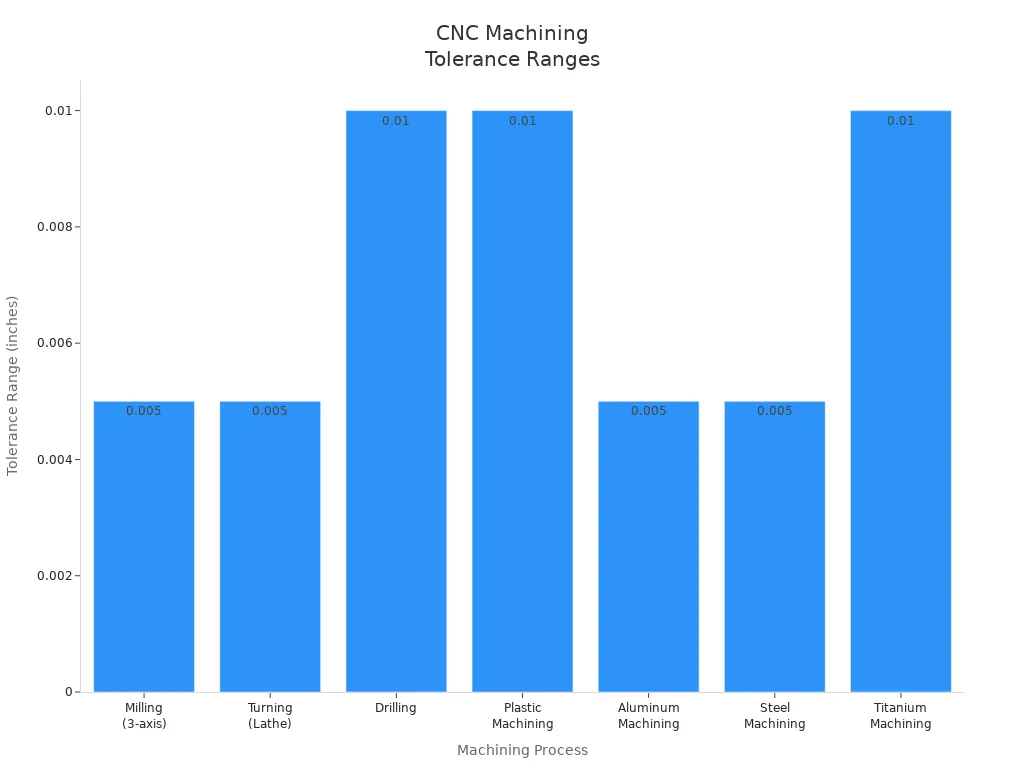
Tip: Use the loosest tolerance that still works for your part. Tighter tolerances can cost more money and take more time.

Geometric dimensioning and tolerancing uses symbols to control the shape, direction, and place of features. gd&t helps you make sure parts fit and work together, even if their sizes are a little different. This method is more advanced than just using dimensional tolerances.
gd&t has four main groups of tolerances:
Form tolerances: Control the shape of a feature. Flatness and roundness are examples. These tolerances make sure surfaces are smooth and shapes are correct.
Orientation tolerances: Control the angle of one feature to another. Parallelism and perpendicularity are examples. These tolerances help parts line up when you put them together.
Location tolerances: Control where features are placed. The true position symbol shows how far a hole or slot can move from its exact spot. This is important for parts that must fit together.
Runout tolerances: Control how much a feature wobbles when it spins. This is important for shafts and spinning parts. Runout and concentricity tolerances keep parts spinning smoothly.
Aspect | GD&T | Traditional Tolerances |
|---|---|---|
Communication of Design | Provides precise communication of design intent | Controls size only, not feature relationships |
Control of Features | Addresses relationships between features, form, and orientation | Controls size of features like length and diameter only |
Tolerance Specification | Allows for larger tolerances while ensuring part interchangeability | Often results in tighter tolerances without context |
Key Concepts | Uses datums, feature control frames, and gd&t symbols | Relies on linear dimensions and basic tolerances |
You use datums as starting points for measuring features. Feature control frames show how much each geometric feature can change. gd&t symbols include flatness, perpendicularity, and true position. These symbols help you share your design clearly.
Note: Using geometric dimensioning and tolerancing can let you use bigger tolerances without losing function. This can save you time and money.

Surface finish tolerances control how smooth or rough a part’s surface feels and looks. You use Ra values (measured in micrometers) to show the finish you need. The right surface finish can change how parts slide, seal, or look.
Surface Finish Type | Ra Value (µm) | Application Description |
|---|---|---|
Standard Machined Finish | 3.2 | Common for non-critical surfaces |
Fine Finish | 1.6 | Needed for better looks or sliding parts |
High-Precision Finish | 0.8 or lower | Used for sealing, medical, or mirror-like parts |
Remember: Smoother finishes often need extra steps like grinding or polishing. Only use fine finishes where they are really needed.
If you understand and use these types of tolerances, you can make sure your cnc machined parts meet all design and function needs. Use dimensional tolerancing for basic size control. Use geometric dimensioning and tolerancing for advanced control of shape, direction, and place. Use surface finish tolerances to get the look and feel you want. When you use all these methods together, your parts will fit, work, and last.
GooDa Machinery gives you tools to make parts very precise. The Machining Center models, like LJ-855 and WJ-800, help you get tight tolerances. You can pick vertical or horizontal machines for your project.
Vertical Machining Centers, like LJ-855, are good for parts needing fine detail. These machines work well for jobs with small and complex features. The big worktable and strong frame keep your precision steady.
Horizontal Machining Centers, like WJ-800, are best for heavy-duty parts. These machines handle big pieces and tough materials. You get reliable precision even with large or hard parts. Both types use advanced controls and automatic tool changers. This technology helps you keep tolerances tight every time.
You must match your tolerance choices to what your cnc machine can do. Different machines have different precision levels. GooDa’s Machining Centers can reach tolerances as tight as ±0.001 inches. The machine type, tools, and setup affect your results.
High-precision machines let you make parts with tiny errors.
Machine calibration and operator skill are important for high precision.
You need to think about tool access and how you hold the part. These steps help you reach tight tolerances.
When you plan your process, pick the right machine for your part’s size and shape. This helps you get the best precision and saves time.
You get the best results when you work closely with your cnc machining partner. GooDa Machinery helps you at every step. You can talk with design engineers, manufacturing experts, and quality teams. Each group has special knowledge. Teamwork helps you understand what your parts need and how to make them with the right tolerances.
Early talks with your manufacturer help you balance function and precision.
Working together leads to faster production and lower costs.
You get more reliable parts when everyone shares ideas.
Tip: Start your project with open communication. This helps you avoid mistakes and reach your precision goals.
GooDa Machinery’s advanced Machining Centers and expert support help you master precision for every job. You can trust these machines to deliver the accuracy your parts need.
Some people think using tight tolerances everywhere is best. But this can make your project cost a lot more money. It can also make things take longer to finish. If you pick tolerances that are too tight, you need special machines and extra steps. This means the work takes more time and costs more. You might have to throw away more parts that do not pass checks. You also need to check the quality more often, which adds to the cost.
If tolerances are too tight, normal changes in the process can make scrap. This slows down production.
Over-tolerancing means you need better machines, which cost more.
More time and extra checks make things more expensive.
Throwing away more parts wastes materials and money.
Making things more complicated can make the wait longer.
Always ask if a part really needs a tight tolerance. If it does not, use a looser one. This helps you save money and finish on time.
You can pick standard tolerances or make your own. Standard tolerances, like ISO 2768, work for most parts. They help you get good results and keep costs down. Most CNC jobs use ±0.13 mm (about ±0.005″) for metals. This works for many things and stops problems with too many tight spots.
Machining Process | Standard Tolerance |
|---|---|
Milling (3-axis) | ± 0.005″ or 0.13 mm |
Lathe | ± 0.005″ or 0.13 mm |
Engraving | ± 0.005″ or 0.13 mm |
Surface Finish | 125RA |
Custom tolerances are only for special needs. If you go from standard to tight tolerances, the price goes up fast. For example, going from ±0.1 mm to ±0.05 mm can make the cost 20-40% higher. If you need ±0.01 mm, the price can double or even be four times more.
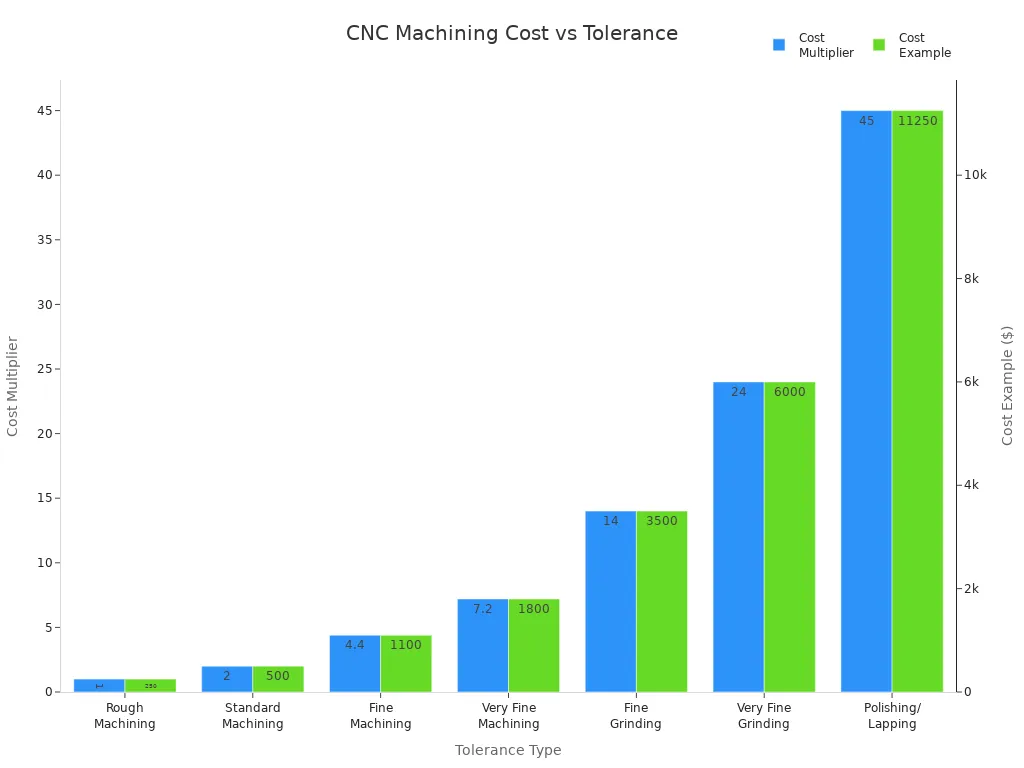
Note: If you need tighter than ±0.02 mm, you need special steps and much higher costs.
You can balance how your part works and what it costs. First, think about what your part must do. Set tolerances based on how it fits and works with other parts. Think about the fit you need—clearance, transition, or interference. Check if things like heat or shaking mean you need tight tolerances.
Look at what your part must do.
Pick the lowest precision needed for each part.
Think about how parts fit and real working conditions.
Make sure you allow for small errors when parts go together.
Tighter tolerances cost more because you need better machines and more checks. The price does not go up slowly. It jumps a lot when tolerances get very tight. Always use the loosest tolerance that still works for your part.
GooDa Machinery helps you find the right mix. Their Machining Centers give you good quality and accuracy. You can use standard tolerances for most jobs. Only use tight tolerances when you really need them. This way, you save money and work faster.
Tolerance Type | Cost Multiplier | Cost Example (for a 2" cube) |
|---|---|---|
Rough Machining (+/- 30 mil) | 1x | $250 |
Standard Machining (+/- 5 mil) | 2x | $500 |
Fine Machining (+/- 1 mil) | 4.4x | $1,100 |
Very Fine Machining (+/- 0.5 mil) | 7.2x | $1,800 |
Fine Grinding (+/- 0.2 mil) | 14x | $3,500 |
Very Fine Grinding (+/- 0.1 mil) | 24x | $6,000 |
Polishing/ Lapping (+/- 0.05 mil) | 45x | $11,250 |
Tip: Talk to your manufacturer early. This helps you pick the right tolerances and avoid expensive changes later.
It is important to explain your needs clearly. This helps you get the right machined parts. You must show what you want in a way your manufacturer understands. This step makes sure your parts fit, work, and look right.
You should always make detailed engineering drawings for your parts. These drawings need to show all the important things, like:
Dimensions and tolerances for every important feature
Material type and grade
Surface finish needed
Special instructions or notes for making the part
A good drawing is easy to read and helps stop mistakes. You should use geometric dimensioning and tolerancing (GD&T) symbols. These symbols help control form, orientation, and location. This method stops you from making your design too strict. Only use tight tolerances where you really need them. This makes your parts easier to make and saves money.
You must use the right standards and symbols on your drawings. These standards help everyone understand your needs, even if they are far away.
Standard | Purpose & Scope |
|---|---|
ISO 2768-1 | General Tolerances for Linear & Angular Dimensions |
ISO 2768-2 | General Tolerances for Geometric Features |
ISO 286-1/2 | System of Limits and Fits for shafts and holes |
ISO 1101 | Geometric Dimensioning and Tolerancing (GD&T) |
ISO 1302 | Surface Texture Indication |
ISO 8015 | Fundamental Tolerancing Principle |
Tip: Always check that your drawings use the newest standards. This helps your manufacturer follow your instructions without mistakes.
You need to make sure your supplier knows your cnc machining tolerances. Start by showing all important sizes and tolerances before you talk to your manufacturer. Share both 3D models and detailed 2D drawings. Use GD&T symbols to show exactly what you want.
Talk about material choices with your supplier to match your tolerance needs.
Ask for a design-for-manufacturing (DFM) review. This helps you find problems before making the parts.
Keep talking with your supplier during the whole process. This way, you can fix problems fast.
GooDa Machinery gives expert help for technical communication. Their team helps you check drawings, explain needs, and answer questions about tolerances. You can ask their engineers for advice at any time in your project.
You must check your parts to make sure they meet your tolerance needs. Different tools and machines help you measure and check your parts:
Inspection Method | Description |
|---|---|
Basic Measurement Tools | Calipers, micrometers, and depth gauges for checking sizes. |
Height Gauges | Measure vertical features from a flat surface. |
Go/No-Go Gauges | Quickly check if a feature is within tolerance. |
Coordinate Measuring Machines (CMMs) | Provide precise 3D measurements for complex parts. |
Optical Comparators | Project a part’s profile for visual checks. |
Surface Roughness Testers | Measure how smooth or rough a surface is. |
Specialized Gauges and Fixtures | Custom tools for unique or complex features. |
CMMs give very accurate and automatic checks for hard shapes. They help you collect data and make reports for quality control. Always use the right inspection tool for your part’s features and tolerances.
Note: Good communication and clear drawings help you avoid mistakes and get the best results from your manufacturer.
Some people think the tightest tolerances are always best. But this is not true. Using very tight tolerances can cause many problems. It makes the machinist’s job much harder. It also makes your part cost more and take longer to finish.
If you ask for tighter tolerances than needed, your costs can double or triple. Your part may not work any better.
Asking for ±0.01mm on deep holes means you need special tools. This can make your part three times more expensive.
Complicated shapes with tight tolerances slow down how fast parts are made.
Mistake Description | Impact on Cost |
|---|---|
Over-specifying tolerances without functional necessity | Can double or triple costs with no functional benefit |
Specifying ±0.01mm on deep holes over 5xD | Can triple part cost due to specialized tooling requirements |
Over-complicating geometries and tolerances | Leads to increased costs and production times |
Ultra-precision tolerances need special machines and tools. These jobs take much longer to finish. The price can go up by 24 times compared to normal machining. You also get more waste because small mistakes can ruin a part. Tools wear out faster, so you have to replace them more often.
Tip: Only use tight tolerances where your part really needs them. This saves money and helps you finish your project on time.
If you do not clearly show what you want, you can have big problems. Ambiguous specifications confuse the machinist. They may not know what size or finish you want. This can cause:
Bad products
Extra costs to remake parts
Delays for your customers
Harm to your reputation
You might also get slow quotes, surprise costs, or parts that get rejected. Always use clear drawings and standard symbols. This helps your manufacturer know what you need and make the right part the first time.
Note: Clear communication stops mistakes and keeps your project on track.
You should always listen to your manufacturer’s advice. If you do not, you might pick tolerances that are too tight or hard to make. Standard tolerances, like ±0.010″, are easy for most machines. If you ask for ±0.005″ or tighter, you need extra steps and special setups. This can make your part cost 25–40% more or even double the price.
Tolerance Type | Description | Impact on Manufacturing |
|---|---|---|
Standard Tolerances | Typically ±0.010″ for cut features | Achievable with primary manufacturing processes, can be produced on standard equipment with normal inspection procedures. |
Tight Tolerances | ±0.005″ or tighter for cut features | Often require secondary machining, fixture-based manufacturing, and increased inspection complexity, leading to higher costs and potential quality issues. |
Cost Multiplier | Moving from ±0.010″ to ±0.005″ | Can increase part cost by 25–40%, doubling costs for tighter tolerances. |
Working with your manufacturer gives you better results. They can help you choose the right tolerances for your part and your budget.
Always ask for feedback from your machining partner before you finish your design.
Inspection is a key step in CNC machining. If you skip or rush this step, you risk many problems. You might think your parts look fine, but small errors can hide in the details. These errors can cause big trouble later.
When you do not check tolerances, your parts may not match the design. This can lead to delays during assembly. Workers may struggle to fit pieces together. Sometimes, you must stop the whole process to fix mistakes. This wastes time and money.
You also face safety risks. Parts that do not fit right can fail when used. For example, a shaft that is too loose may slip out. A hole that is too small may crack under pressure. These failures can damage equipment or even hurt people.
Here are some common problems that happen when you neglect inspection:
Parts do not fit together as planned, causing assembly delays.
Components that do not meet tolerance can fail under load, risking safety.
You may see more errors and defects, leading to wasted materials.
Rework and scrap costs increase because you must fix or replace bad parts.
The final product may not work as intended, hurting your reputation.
Tip: Always use the right inspection tools for your job. Calipers, micrometers, and coordinate measuring machines (CMMs) help you check if your parts meet the required tolerances.
You should set up a clear inspection plan before you start machining. Decide which features need checking and how often you will check them. Use simple tools for basic checks. For complex shapes, use advanced machines like CMMs. Keep records of your inspections. This helps you find problems early and prove your parts meet the standards.
Regular inspection also helps you spot trends. If you see the same error again and again, you can fix the process. This keeps your quality high and your costs low.
Remember, inspection is not just about finding mistakes. It is about making sure every part meets your standards. When you take inspection seriously, you protect your business, your customers, and your team.
Neglecting inspection can lead to misaligned parts, safety hazards, and wasted resources. You can avoid these risks by making inspection a regular part of your CNC machining process. This step ensures your parts fit, function, and last as designed.
You can learn to control tolerances for machined parts by taking simple steps. First, decide what each feature should do. Make a checklist to help you choose the right tolerance for every part. Only use tight tolerances for features that affect how the part works, keeps people safe, or helps it perform well. Use loose tolerances for areas that are not important. Always talk clearly with your machining partner. GooDa Machinery gives you tools and support to help you get high precision and try new ideas in every project.
Tolerances show how much a part’s size or shape can change. You use them to make sure parts fit and work well. Tolerances help you control quality.
You pay more for tight tolerances because machines need extra steps and checks. You may need special tools. More time and skill are needed to meet strict limits.
You look at what your part must do. Use tight tolerances for important features. Use looser tolerances for less critical areas. Talk with your manufacturer for advice.
GD&T uses symbols to show how much a part’s shape, direction, or position can change. You use it to make sure parts fit and work together, even if sizes vary.
You add numbers and symbols next to each feature. Use standards like ISO 2768 or GD&T. Clear drawings help your manufacturer understand your needs.
You may get parts that do not fit or work. This can cause delays, waste, or safety problems. Always inspect your parts to make sure they meet your standards.
GooDa Machinery gives you high-precision machines and expert support. You get help with choosing, setting, and checking tolerances for your CNC machined parts.
You can use standard tolerances for most parts. Use custom tolerances only when you need special fits or functions. Standard tolerances save you time and money.