


When you compare a CNC milling machine to a machining center, the main difference is automation and tool handling. A machining center is a more advanced version of the milling machine, with automatic tool changers and multi-axis abilities. This guide helps you choose which machine is right for your production needs.
The global CNC machine market shows growing demand in many industries. Look at these predictions:
Metric | Value |
|---|---|
Projected CAGR (2023-2028) | 5.99% |
Market increase (USD) | 23.23 billion |
APAC contribution to growth | 41% |
This growth shows that manufacturers are using CNC machining more and more. Knowing the differences between a milling machine and a CNC machining center helps you make smart buying choices.
A machining center can switch tools by itself; a milling machine needs a person to change them.
Automatic tool changers save hours every day and allow machines to run without anyone watching, even overnight.
Multi-axis machining centers work with complex parts in just one setup, so they use fewer fixtures and make fewer errors.
Machining centers cut cycle times by 20-30% because they change tools faster and run at higher speeds.
Milling machines are good for making a few test parts. Machining centers are better for making many parts at once.
Machining centers cost more to buy, but they pay for themselves in 12-18 months when used a lot.
Pick based on how many parts you make, how complex they are, and what you can spend.
Before you pick between these two machines, you need to know what each one does. A cnc milling machine focuses on milling operations. It removes material from a workpiece using rotating cutting tools. A machining center does much more. It can drill, tap, bore, and mill in one setup. This broader capability makes it a versatile workhorse in modern manufacturing.
A cnc milling machine uses computer controls to guide cutting tools. You program the machine with coordinates, and it follows those instructions precisely. The machine moves the workpiece or the tool along different axes to shape the material.
You will find several key parts in every cnc mill. The spindle holds the cutting tool and rotates it at high speed. The table secures the workpiece and moves it into position. The control unit reads your program and sends signals to the motors. Together, these components perform cnc milling with accuracy.
How does cnc milling work? You start by designing a part in CAD software. Then you convert that design into G-code, which the machine understands. The cnc milling process removes material layer by layer. Each pass cuts deeper until the part reaches its final shape. You must change tools manually when you need different operations. This step takes time and requires your attention.
Most cnc milling machine units operate on three axes. The X and Y axes move the table horizontally. The Z axis moves the spindle up and down. This setup handles flat parts and simple geometries well. You can machine pockets, slots, and holes with basic cnc milling operations.
Manual tool changes define this machine type. You stop the spindle, remove the current tool, and insert a new one. This process interrupts production. For small batches, the interruption matters little. For large runs, it slows you down considerably.
A cnc machining center builds on the milling machine concept. It adds automation and expands your capabilities. You can perform multiple operations without stopping the machine. This efficiency makes it ideal for complex parts and higher production volumes.
The defining feature of a machining center is the automatic tool changer. This system stores many tools in a magazine. When your program calls for a different tool, the machine swaps it automatically. No human intervention is needed. How does a cnc machining center work? It follows your program, changes tools, and completes operations without stopping. This automation reduces cycle times and frees you for other tasks.
Machining centers also offer more power. Spindle power ranges from several kilowatts to tens of kilowatts. This strength lets you cut harder materials and remove material faster. The machine structure is larger and more rigid, which improves stability during heavy cuts.
You will find several configurations of cnc machining center units. Vertical machining centers have the spindle oriented vertically. They suit flat parts and are the most common type. Horizontal machining centers position the spindle sideways. They excel at heavy cutting and chip removal. Five-axis machines add rotational movement. They can reach complex angles and undercuts without repositioning the workpiece.
Each type serves different needs. Your choice depends on the parts you produce and the precision you require. A cnc machine with more axes offers greater flexibility but costs more. Understanding these differences helps you match the machine to your production goals.
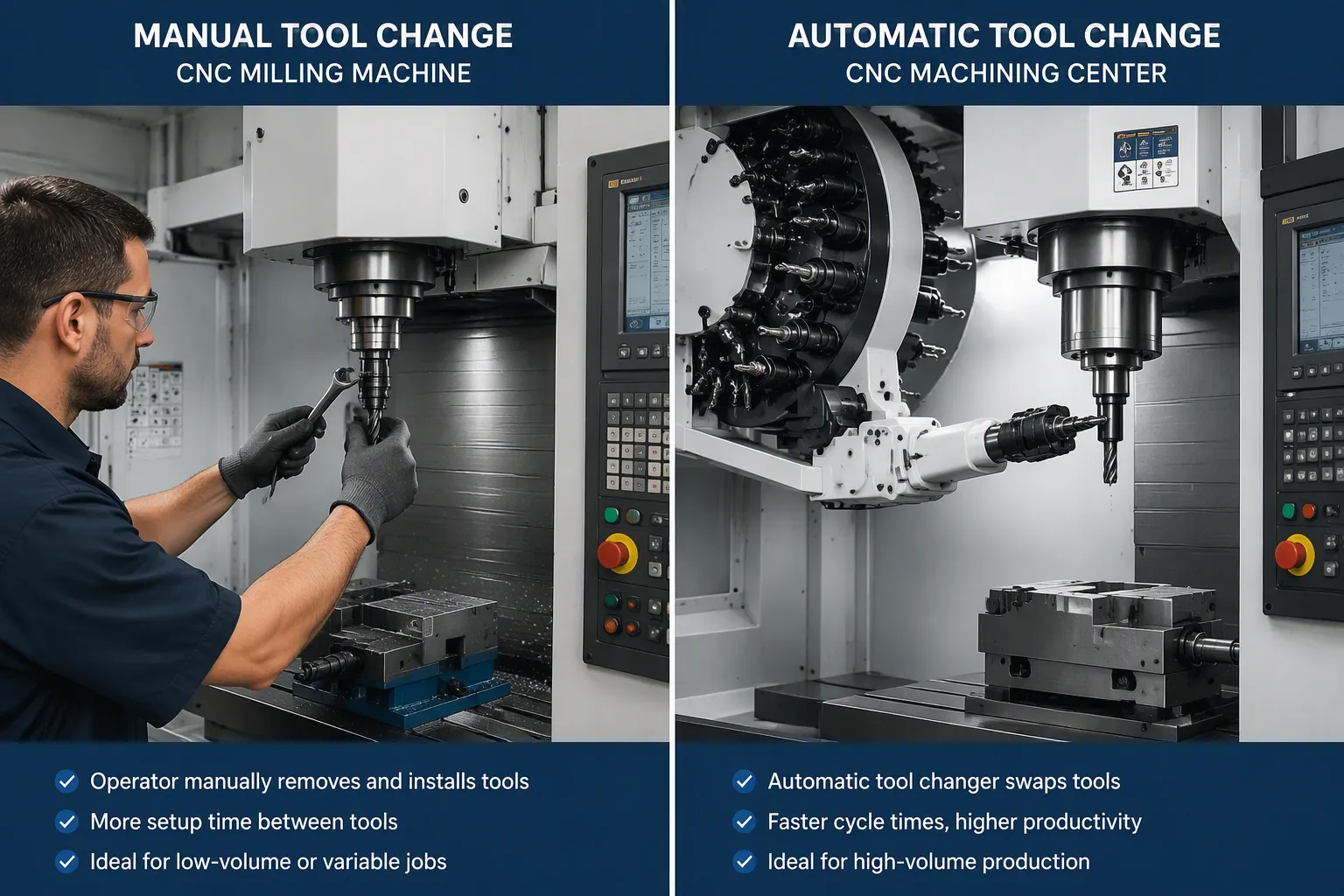
Now you know what each machine is. Here is a clear comparison. The main difference between a cnc milling machine and a cnc machining center is that the machining center has a tool magazine and an automatic tool changer. This one feature changes how you work, how long jobs take, and what parts you can make. Let's look at the key differences in three main areas.
The tool changing system is what separates these two machines. With a cnc mill, you must stop production and swap tools by hand. A machining center does this job on its own. This difference directly affects your setup time and labor costs.
With a cnc milling machine, you have to stop the spindle, loosen the collet, take out the current tool, and put in the next one. This takes three to five minutes each time. You must stay near the machine for the whole job. Every operation that needs a different tool means another stop.
A cnc machining center uses an automatic tool changer (ATC). The machine stores many tools in a magazine. When your program asks for a new tool, the ATC swaps it in eight to twelve seconds. You do not touch the machine during this process. The spindle keeps working through the whole job without stopping.
The time saved adds up fast. Think about a typical production sheet that needs two tool changes:
Metric | Manual Tool Change | ATC (Automatic Tool Changer) |
|---|---|---|
Time per tool change | 3–5 minutes | 8–12 seconds |
Downtime per sheet (2 changes) | 10 minutes | 24 seconds |
Daily downtime (20 sheets) | 200 minutes (3.3 hours) | 8 minutes |
Daily time saved with ATC | — | 192 minutes (3.2 hours) |
You save over three hours every day with an ATC. That time directly means more parts made. You also lower labor costs because you do not need an operator watching every tool change. This efficiency is one of the main advantages of cnc milling when you pick a machining center.
The number of axes decides what shapes you can cut. A normal cnc milling machine works on three axes. A machining center can have four, five, or more axes. This gives you much more machining flexibility.
A three-axis cnc mill moves the table along the X and Y axes. The spindle moves along the Z axis. This setup works for flat surfaces, pockets, and simple holes. You must move the workpiece by hand for any angled feature.
A five-axis cnc machining center adds rotational movement. The table can tilt and rotate while the spindle moves in three directions. This lets you machine complex angles in one setup. Typical five-axis machines have large travel ranges:
Parameter | Value |
|---|---|
X-axis travel | 800 mm |
Y-axis travel | 450 mm (total: 1,115 mm) |
Z-axis travel | 465 mm |
Rapid traverse (X/Y/Z) | 65 m/min on all three linear axes |
These travel ranges let you handle large workpieces while keeping high precision throughout the cut.
With more axes, you can machine undercuts, angled holes, and curved surfaces without moving the part. This reduces the need for fixtures. You do not need custom jigs to hold parts at specific angles. The machine reaches those angles by itself. This flexibility is a big advantage of multi-axis machining. The disadvantages of cnc milling on a three-axis machine include limited shapes and more manual setup steps.
Automation levels vary a lot between these machines. A cnc milling machine needs constant operator attention. A cnc machining center can run with little human help. This difference affects your production workflow and your ability to grow.
With a cnc mill, you must be there for every tool change. You also need to watch the cutting process for tool wear or breakage. This hands-on approach works well for small batches where you need flexibility. But it limits how many parts you can make.
A cnc machining center cuts down operator intervention a lot. The ATC handles tool changes. Advanced sensors keep an eye on cutting conditions. You can load a program, start the machine, and walk away. This automation allows lights-out manufacturing. FANUC runs a full lights-out factory that makes about 50 robots per day and runs without supervision for up to 30 days. Makuta Micro Molding produces millions of micro-molded parts each month with human help only for machine setup. These examples show the impact on versatility and efficiency that automation brings.
Machining centers fit easily into automated production cells. You can connect them to robotic loading systems and conveyor lines. This creates a smooth workflow from raw material to finished part. Industry reports show that most manufacturers start with lights-out cells—multiple machines with robotic handling—before trying full-factory automation. Horizontal machining centers are easier to automate than vertical ones because of their design.
A cnc milling machine works well as a standalone unit. You can still get good precision and quality. But you cannot get the same level of unattended operation. The disadvantages of this limit become clear when you scale production.
Feature | CNC Milling Machine | Machining Center |
|---|---|---|
Tool changing | Manual (3–5 min) | Automatic (8–12 sec) |
Axes | 3-axis standard | 4, 5, or more axes |
Automation level | Operator-dependent | Lights-out capable |
Setup time per job | 30–60 minutes saved with ATC | Eliminates manual mounting |
Cost | Lower initial investment | Higher initial investment |
Precision | Good | Excellent with multi-axis |
This comparison table sums up the main differences. Your choice depends on your production volume, part complexity, and budget. A cnc machine with more automation costs more upfront but gives you better long-term efficiency.
The automatic tool changer is the key feature that sets a cnc machining center apart from a standard milling machine. With a cnc mill, you have to stop the spindle and change tools by hand. This takes time and keeps you close to the mill. A machining center with an ATC does this job on its own. In cnc machining, the ATC makes a huge difference. It picks the right tool from the magazine and swaps it within seconds.
The ATC directly boosts your cnc milling efficiency. It cuts down non-cutting time and lets the machine run without you watching it constantly.
Manual tool changes take three to five minutes each time. For a job that needs five different tools, you lose 15 to 25 minutes just switching tools. An ATC brings this down to seconds. The whole tool change process finishes in three to eight seconds. Over a full day, this adds up to hours of extra cutting time. This is a major benefit of modern cnc milling.
With manual changes, you have to stay at the machine. An ATC removes that need. The machine can run through an entire program without you touching it. Many manufacturers use this for lights-out production. They load parts and tools, start the machine, and come back the next morning to finished parts. This raises your cnc milling productivity without adding labor costs.
The size of the tool magazine affects how you plan your cnc milling work. A bigger magazine means fewer stops for manual loading.
A cnc machine with a tool magazine can hold many tools, providing ample storage for various operations. The ATC picks the next tool while the current one is still cutting. The swap itself takes two to eight seconds. This speed keeps the machine cutting almost nonstop.
For batch production, a machining center with a large tool magazine changes how you set up jobs. You can load tools for multiple parts in one setup. This cuts setup time between batches. You also lower the chance of mistakes. For small batches, you get fewer interruptions. For large batches, the time savings grow across hundreds of parts. Any cnc milling operation benefits from this reliability.
The number of axes on your cnc machine controls what shapes you can make. A standard 3-axis cnc mill moves the table along X and Y, while the spindle moves along Z. This setup works well for flat parts, simple pockets, and straight holes. But it has trouble with angled features, curved surfaces, and undercuts. You have to move the workpiece by hand for these shapes. Each move can cause errors and takes extra time.
A 3-axis cnc milling setup limits what you can design. You cannot reach the bottom of a feature or cut an angled wall without tilting the part. This forces you to design parts around what the machine can do. You might add extra steps or use special fixtures to get the shape you need.
A 4-axis or 5-axis cnc machining center rotates the workpiece or the spindle. This rotation lets you reach undercuts and tricky angles without moving the part. You can machine a turbine blade with twisted surfaces or a mold cavity with deep side walls. The extra axes move the tool around obstacles instead of making you flip the part. This gives you much more design freedom.
With a 3-axis cnc milling machine, you need custom fixtures to hold parts at certain angles. These fixtures cost money and take time to design and build. A multi-axis cnc machine removes many of these fixtures. The machine positions the tool at the right angle by itself. You use simple clamps or vises instead of complex jigs. This cuts setup time and lowers your tooling costs.
Multi-axis machines have two working modes. Positional machining, also called 3+2, locks the rotary axes at a fixed angle. The machine then cuts like a 3-axis unit. Simultaneous machining moves all axes at once. The tool follows a smooth path through complex shapes. Each mode serves different needs.
The mode you pick affects your surface finish. Simultaneous 5-axis machining gives smoother surfaces because the tool stays in contact with the workpiece. Positional 3+2 machining can leave marks where the rotary axes lock into place. The table below shows the difference:
Machining Type | Surface Finish (Ra) |
|---|---|
Simultaneous 5-axis | 0.4–1.6 μm (continuous tool paths) |
Positional 3+2 | 1.6–3.2 μm (repositioning marks possible) |
For parts that need high precision and smooth finishes, simultaneous machining works better. You get a cleaner surface without extra finishing steps.
Simultaneous machining needs advanced CAM software. You must program tool paths that coordinate all five axes at once. This takes more skill and longer programming time. Positional 3+2 machining uses simpler programming. You set a fixed angle, then program standard 3-axis tool paths. Many shops start with 3+2 to learn multi-axis work before trying full simultaneous machining. The programming challenge affects your workflow, but the gain in part complexity and surface quality makes it worth the effort. This impact on versatility and efficiency explains why many manufacturers choose multi-axis cnc machining for their hardest projects.
When you measure production efficiency, you look at how many parts you make in a given time. The difference between a cnc milling machine and a machining center becomes clear here. A machining center keeps cutting almost nonstop. A cnc mill stops often for manual tool changes. This gap grows larger with every part you produce.
Cycle time means the total time from starting one part to finishing it. You want this number as low as possible. Every second you save adds up across hundreds of parts. The two biggest factors are tool changes and cutting speed.
You already know that an automatic tool changer swaps tools in seconds. A manual change takes minutes. Think about a job that needs six different tools. With a cnc milling machine, you stop six times. Each stop costs you three to five minutes. That adds up to 18 to 30 minutes of downtime per part. A machining center with an ATC finishes all six changes in under a minute. This difference alone can cut your cycle time by 20 to 30 percent.
You also reduce the risk of errors. When you change tools by hand, you might insert the wrong tool or tighten it incorrectly. These mistakes cause scrap parts and rework. An ATC eliminates these human errors. The machine picks the exact tool your program calls for every time.
Machining centers often come with higher spindle speeds and faster feed rates than standard milling machines, enabling more efficient material removal. This capability directly reduces your cycle time. Faster spindle speed means smoother cuts and better surface finish.
High-speed machining also reduces heat buildup. When you cut faster with lighter passes, the tool stays cooler. This extends tool life and reduces the need for frequent replacements. You spend less time changing worn tools and more time cutting metal.
Your production volume should guide your machine choice. Each machine type has its strengths. You need to match the machine to your order sizes.
For high-volume production, a machining center gives you clear advantages. The ATC keeps the machine running without stops. You can run lights-out operations and produce parts overnight. The multi-axis capability lets you finish complex parts in one setup. You avoid moving parts between machines. This reduces handling time and the chance of damage.
Mass production also benefits from consistency. A machining center repeats the same operations with the same precision every time. You get identical parts across thousands of units. This reliability reduces inspection time and customer complaints.
A cnc milling machine suits low-volume work and prototyping. You might make one or two parts for testing. You might handle custom orders that change frequently. The manual tool change gives you flexibility. You can switch tools quickly to try different approaches. You do not need to program complex tool paths for a multi-axis machine.
Job shops often handle many small orders with different requirements. A milling machine costs less to purchase and maintain. You can afford to keep several units for different tasks. This setup lets you handle multiple jobs at once. For small batches, the downtime from manual tool changes matters less. You spend more time setting up each job than actually cutting.
The choice between these machines depends on your typical order size. High volume demands automation. Low volume rewards flexibility. Many shops use both types to cover their full range of work.
The price gap between a CNC milling machine and a machining center affects your buying choice. You need to look past the price tag. The real question is how fast each machine pays for itself. This section breaks down the costs and returns you can expect.
Your first cost sets the base for your budget. A CNC milling machine costs less at the start. A machining center costs more but does more jobs. You need to weigh these numbers against your production goals.
Entry-level CNC milling machines start at a lower price. You can find basic models that fit a small shop budget. These machines handle simple parts and light runs. They lack the automation that raises costs.
High-end machining centers have a higher price. You pay for the automatic tool changer, multi-axis movement, and advanced controls. The price gap between these two choices can be large. You must decide if the extra features are worth the higher cost for your work.
Financing options affect your cash flow. Many sellers offer payment plans that spread the cost over years. You should figure out the total cost of ownership, not just the purchase price. This includes setup, training, upkeep, and supplies over the machine's life.
A machining center used a lot pays back its cost fast. For a mid-sized company, a well-used machining center in the $15,000–$200,000 range often pays for itself in 12–18 months. This payback time assumes you run the machine at 60% or more. At that level, the machine makes enough money to cover its cost in a year and a half.
Ongoing costs affect your profit. You must plan for regular upkeep and replacement parts. The machine's complexity drives these costs.
A machining center with an automatic tool changer has more moving parts. These parts wear out and need adjustment. You must schedule regular checks to keep the ATC aligned. A misaligned tool changer can cause crashes and damage your spindle.
A CNC milling machine has a simpler design. You change tools by hand, so there are fewer parts to maintain. This simplicity lowers your upkeep work. However, you still need to check spindle alignment and table level regularly.
Both machine types use cutting tools, coolants, and lubricants. The spindle wears over time no matter the machine type. You should include these supplies in your operating budget.
The downsides of CNC milling show up when you calculate tooling costs for high-volume work. Manual tool changes mean more handling, which raises the chance of tool damage. You also spend more time per part, which increases your labor costs. These downsides add up across thousands of parts.
The main downsides of a machining center come from its complexity. More parts mean more ways to break. You need skilled workers for repairs. These costs can cancel out some of the efficiency gains from automation.
Your choice between a milling machine and a machining center depends on your budget and production volume. A CNC milling machine suits low-volume work with lower start costs. A machining center gives better long-term value for high-volume production. Figure out your expected use and payback time before you decide.
Now you have the full picture of both machine types. The next step is matching that knowledge to your specific production needs. Your choice depends on three factors: order volume, part complexity, and budget. This section walks you through each scenario and helps you make the right call.
Small batch work includes prototyping, custom one-off parts, and short production runs. These jobs change frequently. You might make five parts one week and twenty completely different parts the next. This variety demands flexibility above all else.
A cnc milling machine gives you that flexibility naturally. You control every tool change by hand. You can swap tools quickly to test different cutting approaches. You can adjust feeds and speeds on the fly without reprogramming complex tool paths. This hands-on control lets you experiment and refine your process.
Manual tool changes also let you use any tool you own. You are not limited to what fits in a tool magazine. You can pull out a specialty cutter for one operation and switch back to a standard end mill for the next. This versatility matters when you handle diverse jobs with unique requirements.
The cost advantages of cnc milling for prototyping are clear. A cnc milling machine has a lower upfront cost because of its simpler design. You save money before you even cut your first part. Operational complexity is also lower. The machine is simpler to learn and operate. You can train new staff quickly without extensive programming knowledge.
For low production volumes, these savings matter. You do not need the automation of a machining center when you only make a handful of parts. The table below shows the cost comparison:
Cost Factor | CNC Milling Machine | CNC Machining Center |
|---|---|---|
Initial Investment | Lower upfront cost due to simpler design | Higher upfront cost due to ATC and broader functionalities |
Operational Complexity | Simpler to learn and operate | Requires more operator expertise |
Suitability for Prototyping | Suitable for lower production volumes, ideal for cost-sensitive prototyping | Better for complex, high-volume manufacturing, less cost-efficient for prototyping |
This cost structure makes a milling machine the smart choice for job shops and R&D departments. You get the precision you need without paying for features you will rarely use.
When your orders grow, your priorities shift. You need speed, consistency, and minimal downtime. A cnc machining center delivers on all three fronts. The automation that seemed unnecessary for small batches becomes essential at scale.
The automatic tool changer transforms your production workflow. You load tools once and let the machine run through multiple operations without stopping. This reduces cycle time dramatically. You also gain multi-axis capability. Complex parts that require angled cuts or undercuts finish in one setup instead of multiple operations.
To measure this efficiency, you track key performance indicators. Production downtime measures how often your equipment stops. Overall Equipment Effectiveness (OEE) calculates as Availability × Performance × Quality. An increase in OEE indicates more efficient machinery utilization. Capacity utilization shows what percentage of your production capacity you actually use. These metrics help you identify bottlenecks and improve your process.
Large orders demand identical parts every time. A machining center delivers this consistency. The ATC picks the same tool at the same position every cycle. The multi-axis movement repeats the same path with high precision. You get the same surface finish and tolerances across thousands of parts.
This repeatability reduces inspection time. You trust the machine to produce the same result. You also reduce scrap rates. Fewer defective parts mean lower material costs and less rework. For automotive parts production, these advantages translate directly to better profitability.
Once you decide which machine type fits your needs, you must choose a manufacturer. The brand you pick affects your machine quality, support, and long-term satisfaction. When evaluating a brand, consider the following aspects.
Look for a manufacturer that offers a variety of machines suitable for your needs, from milling machines to machining centers. A good brand will have a product range that covers both ends of the spectrum, allowing you to find a cnc milling machine for prototyping or a full machining center for mass production. Some manufacturers specialize in specific industries, such as mold and die making, which means their machines are engineered for the demands of that work, offering features like high precision, wide adaptability, and innovative designs that enhance productivity.
A machine is only as good as the support behind it. A reputable brand provides comprehensive solutions beyond just selling equipment, including installation, maintenance, repair, and training services. Ensure that the manufacturer has a strong service network with global presence, offering expert technical support when needed. When evaluating any brand, ask about their service network, response times, and spare parts availability. Look for a partner who will be there when you need help. The right manufacturer becomes a long-term partner in your success.
Your final decision should weigh your production volume, part complexity, and budget against the comparison table. A cnc milling machine suits low-volume, flexible work. A machining center excels at high-volume, complex production. Choose the machine that matches your reality today and your growth plans for tomorrow.
You now see the core trade-off. A machining center delivers superior automation and multi-axis reach, but you pay more upfront. A milling machine offers lower cost and simpler operation. Your production volume, part complexity, and budget decide the winner.
Evaluate your typical orders against the comparison table. For high-volume runs, the advantages of a machining center justify the investment. For prototyping, a milling machine keeps costs low. Whatever you choose, investing in the right cnc machine improves your efficiency. Whether you select a reputable brand, you gain precision and competitiveness. Quality cnc milling services and high precision keep you ahead in today's market.
A machining center has an automatic tool changer. A CNC milling machine needs you to swap tools by hand. This one thing changes how fast you work and how much you can automate.
Yes. The automatic tool changer lets the machine run through many operations without your help. Many shops use this for lights-out production. They load parts and tools, start the machine, and pick up finished parts the next morning.
A CNC milling machine costs less to maintain. It has fewer moving parts and a simpler design. A machining center has more parts like the tool changer and rotary axes. These parts need regular checks and sometimes repairs.
Not always. A 3+2 machining center locks the rotary axes at fixed angles. This handles many angled features without full simultaneous motion. You save money on the machine and programming. Only upgrade to full 5-axis when your parts need continuous curved surfaces.
A mid-range machining center priced between $15,000 and $200,000 often pays for itself in 12 to 18 months. This assumes you run the machine at 60 percent capacity or higher. The time savings from automation cause this return.
Automotive, aerospace, and mold making industries use machining centers most. These sectors make high volumes of complex parts. They need the consistency and speed that automatic tool changers and multi-axis movement give.
Many machine shops offer both types of equipment. They use milling machines for small batches and prototypes. They use machining centers for high-volume orders. You can pick a service provider based on your specific part quantity and complexity.